Why You Crave the Order Button,
Not Just the Food.
Groundbreaking neuroscience shows that dopamine doesn’t reward consumption—it fuels anticipation. Discover why food delivery apps trigger compulsive midnight carts, and how Cravault intercepts the neurochemical loop.
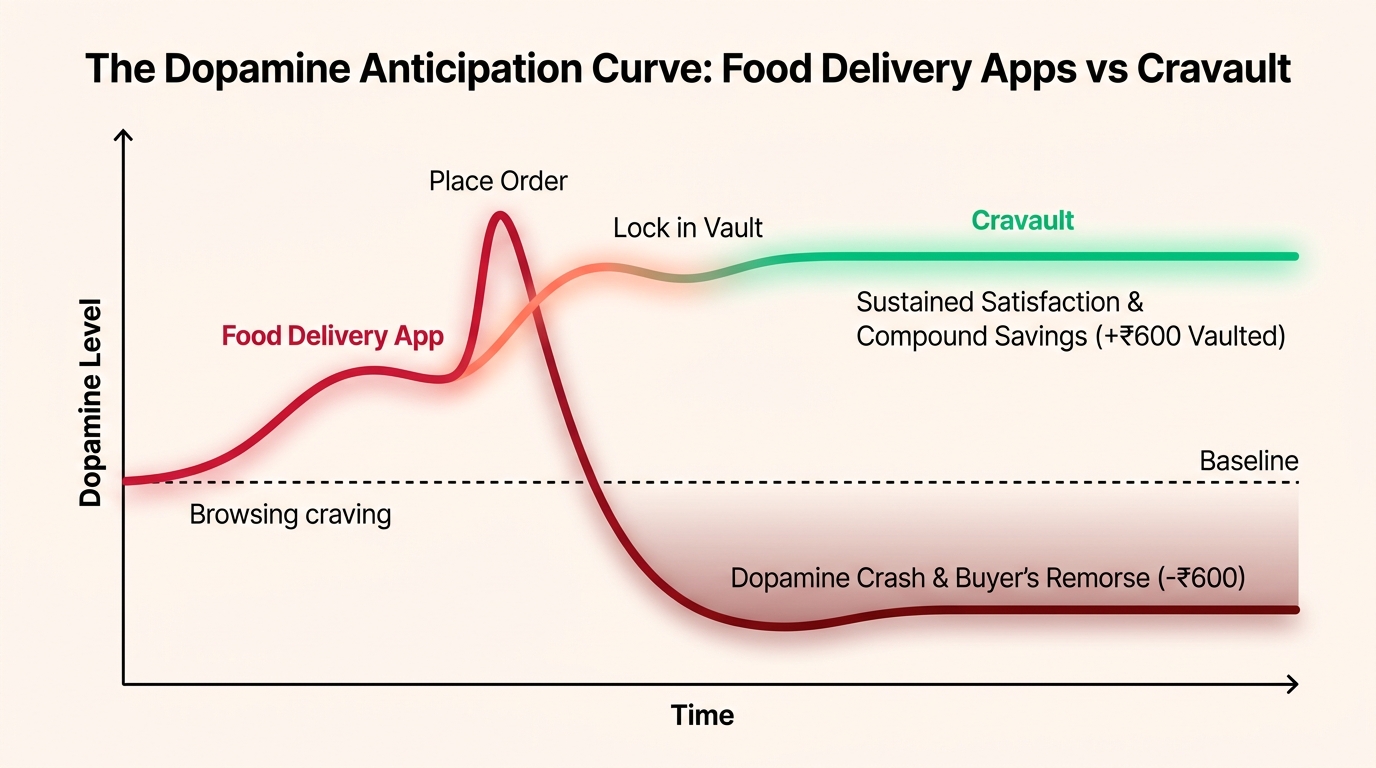
Brain anticipation peaks when tapping “Place Order”—before a single bite of food arrives.
Opponent-process rebound plunges mood below baseline, leaving regret and drained savings.
Full ritual satisfaction, 0 financial damage, and real dopamine redirected into wealth building.
The Dopamine Anticipation Curve
Comparing what happens inside your brain during a standard delivery app order versus a Cravault simulated checkout.
The 5 Stages of the Ordering Dopamine Loop
Click through the phases of an order to see the precise neurochemistry firing in each stage.
Environmental Cue & Cognitive Vulnerability
Standard Delivery App
You are exhausted from work, doomscrolling social media, or lying in bed. A push notification flashes: 'Hungry? 40% OFF your favorite Biryani!' Your stomach isn't actually empty, but your brain registers a rapid dopamine opportunity.
The Cravault Intercept
You feel the exact same impulse or boredom trigger. But instead of letting a delivery algorithm hijack your wallet, you open Cravault, positioned right where food apps used to sit.
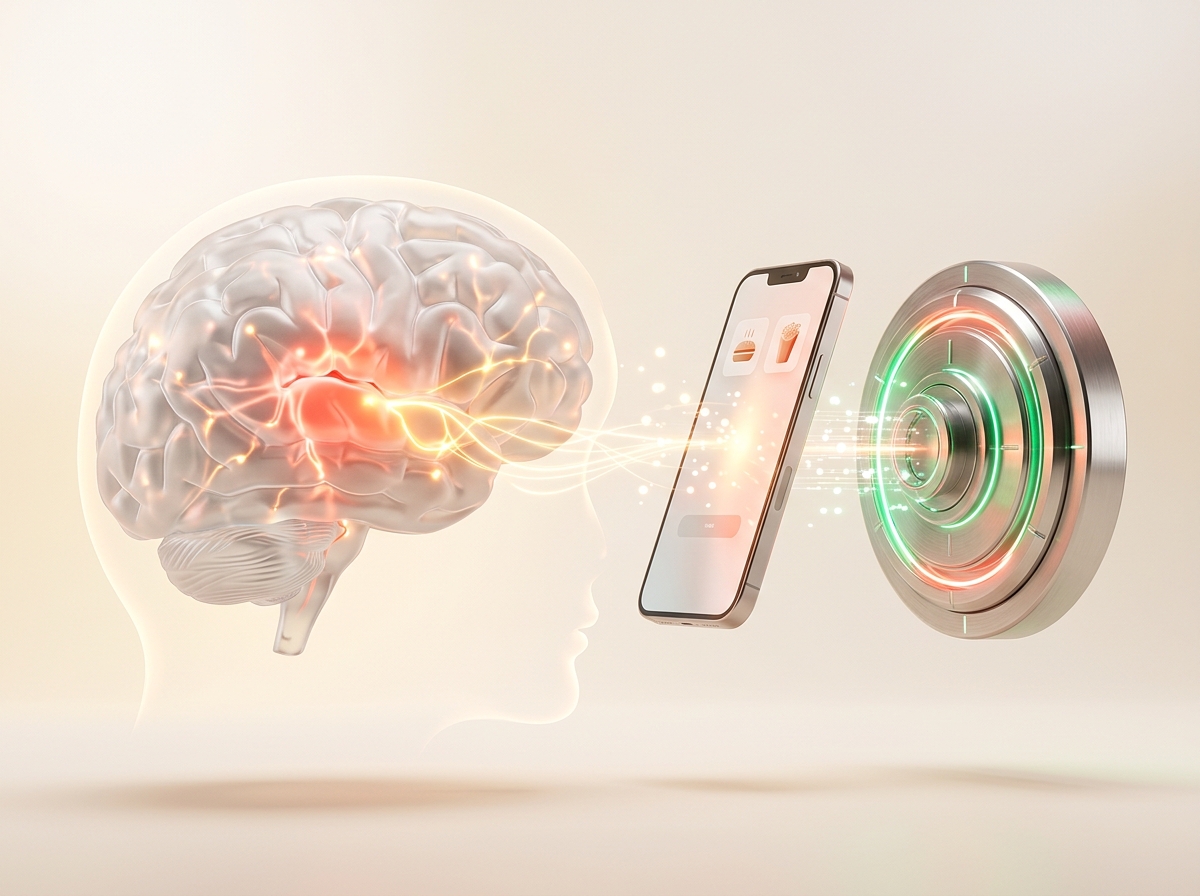
Visual food cues activate the Ventral Tegmental Area (VTA) and amygdala. Cortisol from late-night fatigue weakens prefrontal cortex impulse control, translating emotional stress into apparent hunger.
“Cues don't trigger physical hunger; they trigger an anticipation cascade.”
— Dr. Kent Berridge, Professor of Psychology and Neuroscience, Univ. of Michigan
The Paradox of “Wanting” vs. “Liking”
For decades, popular culture assumed dopamine was the chemical of pleasure. Groundbreaking research at the University of Michigan demonstrated that the brain has two entirely separate circuits:
- 1Incentive Salience (“Wanting”): Controlled by dopamine in the mesolimbic pathway. It generates fierce desire, craving, and obsession to acquire.
- 2Hedonic Impact (“Liking”): Controlled by microscopic opioid hotspots. It produces genuine sensory satisfaction when food is actually consumed.
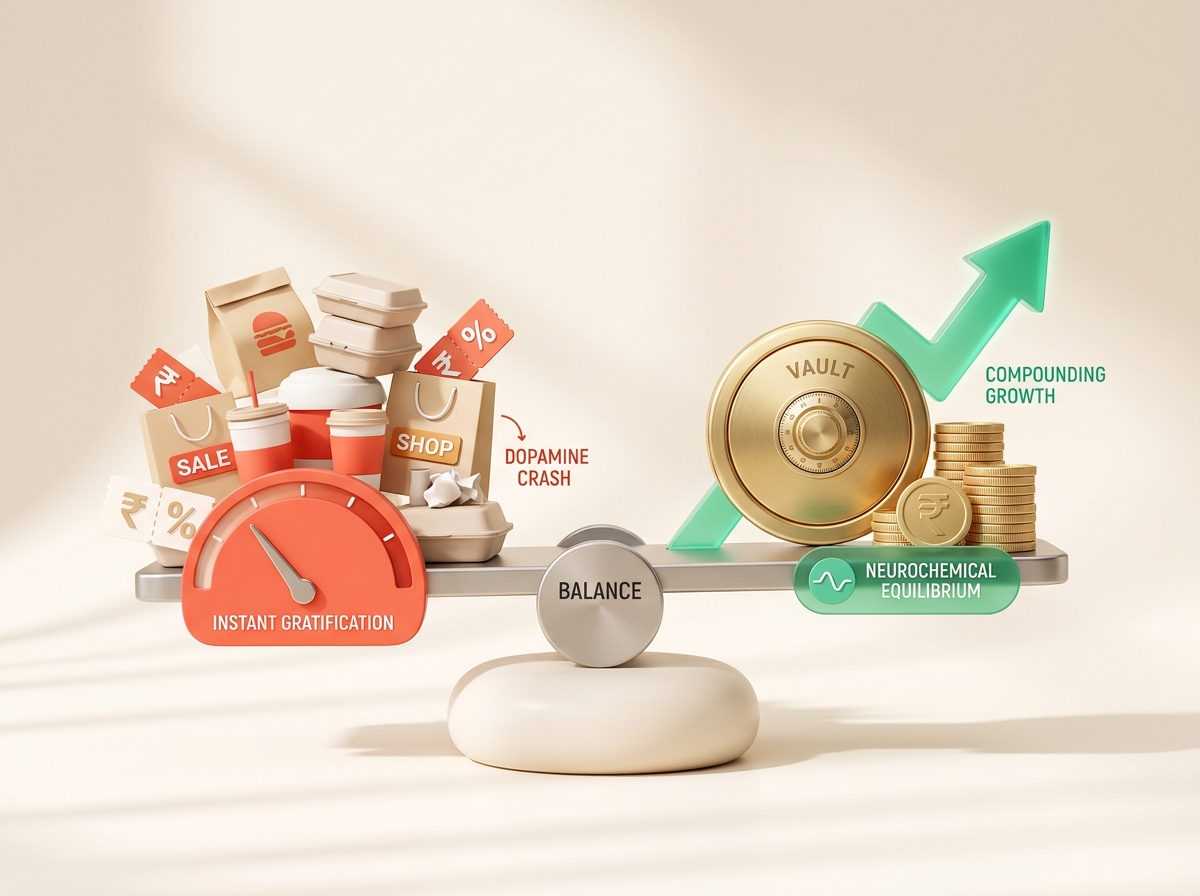
The Dopamine Teeter-Totter: The Pleasure-Pain Balance
In her seminal work Dopamine Nation, Dr. Anna Lembke explains that pleasure and pain are co-located in the same brain region and operate like a teeter-totter.
Every time your brain experiences an easy, hyper-concentrated burst of dopamine (like ordering ₹700 fast food on an app), the brain's homeostatic gremlins immediately press down on the pain side to level the balance.
Frequent delivery app ordering doesn't keep you happy; it down-regulates dopamine receptors, creating chronic restlessness, late-night anxiety, and an inability to enjoy normal home-cooked meals.
The Golden Rule of Habit Change
Why sheer willpower and deleting apps fails 92% of the time, and why Cravault succeeds.
Keep the Cue
You cannot control when late-night boredom or fatigue strikes. The environmental trigger remains the same.
Keep the Routine
Instead of white-knuckling deprivation, you open an app, browse delicious food, assemble a cart, and hit checkout.
Upgrade the Reward
Instead of guilt and empty calories, your reward is vaulted cash, an unbroken streak, and compound interest in your bank.
Calculate Your “Dopamine Tax”
See what your late-night anticipatory ordering is quietly draining from your future net worth.
Assuming avoided spend is routed to mutual fund SIPs instead of late-night delivery apps.
Scientific References & Studies
Cravault is built on peer-reviewed neurobiology, behavioral economics, and clinical addiction research.
Dopamine reward prediction error coding & predictive reward signal of dopamine neurons
Dialogues in Clinical Neuroscience & Journal of Neurophysiology
Demonstrated that dopamine neurons do not fire for the reward itself, but in response to cues predicting the reward. When an unexpected reward cue arrives, dopamine spikes drastically.
Liking vs. Wanting: Food reward and the brain's hedonic hotspots
Current Opinion in Behavioral Sciences
Established the vital neurochemical distinction between 'wanting' (mesolimbic dopamine motivation) and 'liking' (opioid hedonic pleasure). Food ordering platforms exploit 'wanting' independent of true satisfaction.
Dopamine Nation: Finding Balance in the Age of Indulgence
Dutton / Penguin Random House (Stanford University School of Medicine)
Explains the pleasure-pain balance mechanism and neuroadaptation. High-frequency digital stimulation drives baseline dopamine down into chronic deficit states, triggering compulsive loops.
Behave: The Biology of Humans at Our Best and Worst
Penguin Press (Stanford University)
Revealed that dopamine levels in primates and humans are highest during the interval between anticipation and reward delivery, especially under variable conditions (50% probability).
Reward, dopamine and the control of food intake: implications for compulsive eating
Trends in Cognitive Sciences
Documented how hyper-palatable visual cues disrupt standard homeostatic satiety signals in the hypothalamus, triggering compulsive consumption urges in non-hungry states.
The Golden Rule of Habit Change: Cue, Routine, Reward
The Power of Habit / Atomic Habits
Habits cannot be simply eliminated through sheer willpower. Permanent behavioral change happens when you keep the cue and reward, but replace the routine.
Satisfy the Dopamine Rush.
Keep Your Hard-Earned Money.
Experience the full checkout feeling right now with ₹0 charged and real savings added to your vault.